The Applied AI Interview Process: What the Loop Actually Looks Like (2026)
How the Applied AI Engineer and Applied AI interview loop is structured in 2026 — why it differs from a normal SWE loop, the stages you'll face, and what Palantir, OpenAI, Anthropic, Scale AI, and Cohere each weight. Process lengths are reported and approximate.
9 MIN READ · UPDATED 12 JULY 2026
Why the Applied AI loop isn't a normal SWE loop
A traditional software interview grades you in a clean room: a self-contained algorithm, a deterministic right answer, a closed problem. The Applied AI and Applied AI loop deliberately breaks that frame. It drops you into a customer's operational reality, where the requirements are incomplete, the constraints are hidden, and the model itself is non-deterministic. The question is rarely "does your code pass the tests." It's "can you ship something that works inside a messy, regulated, legacy-laden environment, and can you explain it to the person who has to trust it."
Concretely, the assessment axes shift. A classic SWE loop optimizes for scalable, generalized features and asks about sharding, caching, and load balancing. An Applied AI loop optimizes for a client-specific implementation that goes live, and asks about private VPC deployments, SSO and identity, and integrating with systems nobody documented. The coding moves from abstract puzzles to practical work: wire up an API, debug a RAG pipeline, parse a file that real humans corrupted. The success metric moves from uptime and test coverage to go-live dates, adoption, and a measurable business outcome.
The practical implication: pure LeetCode grinding is necessary but nowhere near sufficient. The loop is engineered to find people who can hold engineering depth and customer judgment in the same hour.
The stages you'll typically face
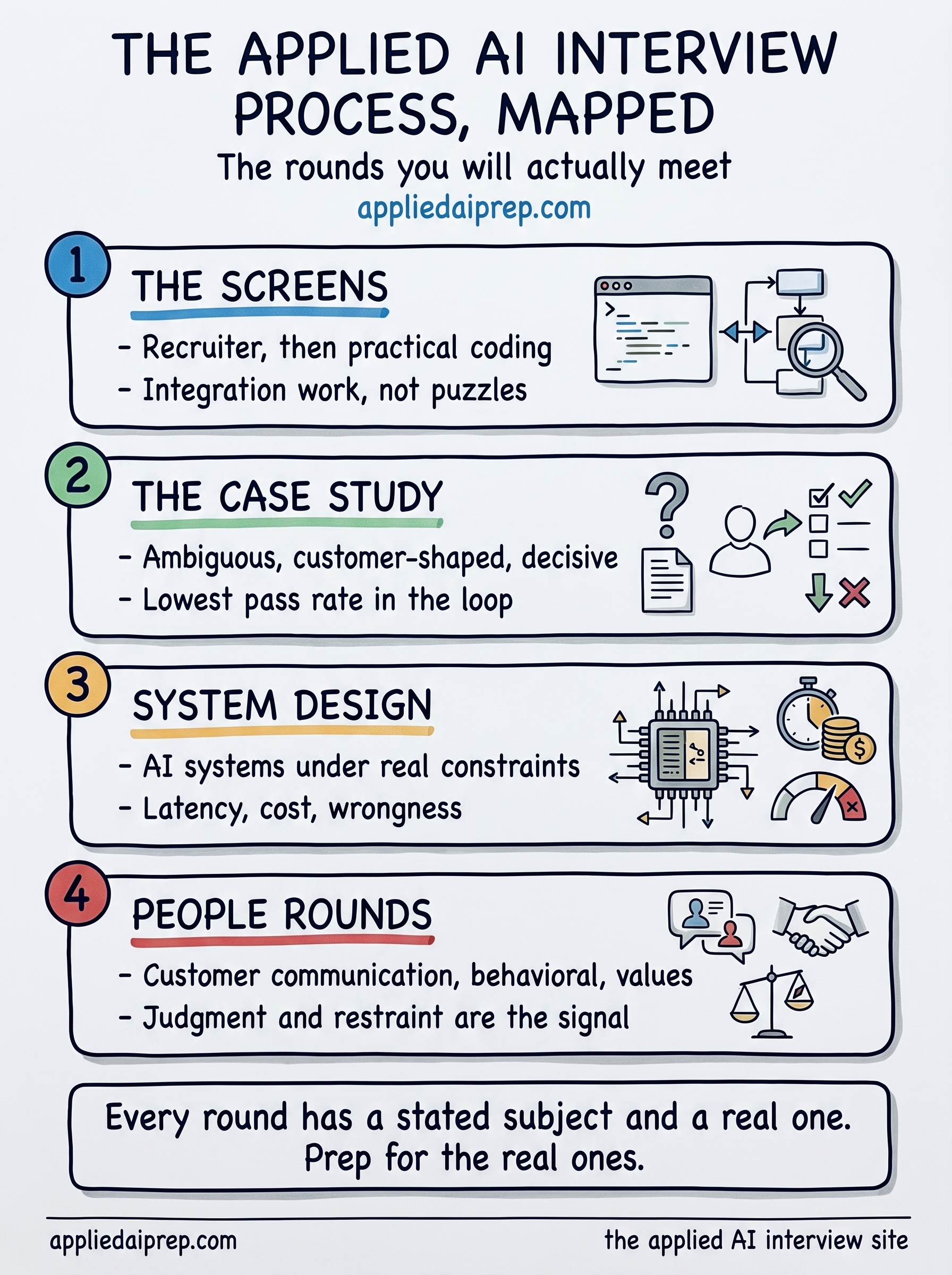
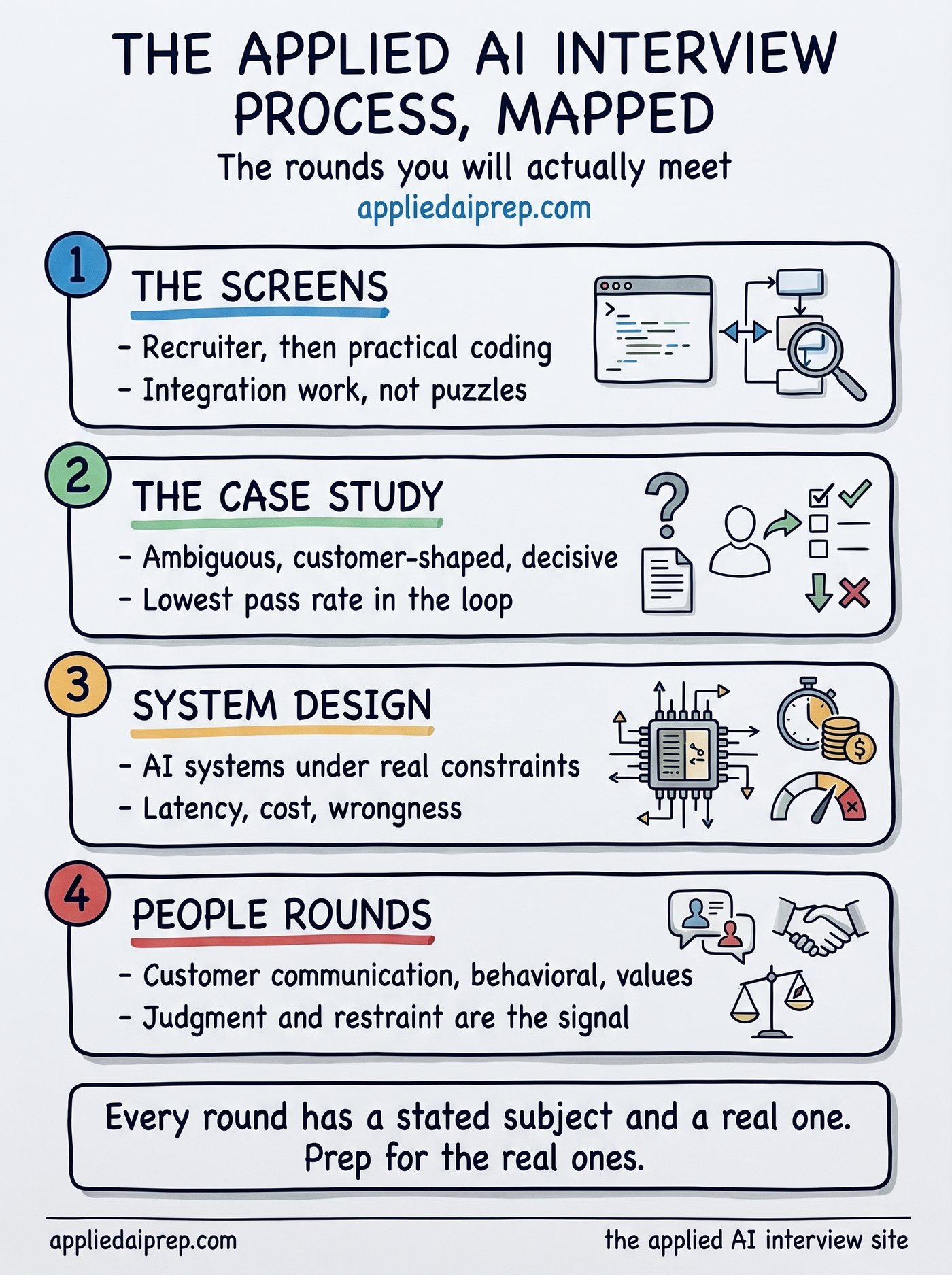
Loops vary by company, but the recurring building blocks are consistent. A recruiter and hiring-manager screen establishes motivation and fit (expect "why forward deployed rather than a normal SWE role" early, and treat it as a real filter, not a warm-up). A practical coding round favors resilient integration code over algorithm trivia: rate limiters, exponential backoff with jitter, messy-CSV or log parsing, a small RAG pipeline you then have to defend.
A system or architecture round leans toward customer constraints rather than textbook distributed systems: a VPC-deployed RAG system under HIPAA, an integration bridge across mismatched auth schemes, an evaluation framework for an agent. An open-ended scoping or decomposition round hands you a vague business problem and watches whether you clarify before you architect. And the round that most surprises people: a customer simulation or roleplay, where a panel plays client stakeholders and you have to scope, communicate trade-offs, and stay composed under pressure. Behavioral and ownership questions are often woven through every round rather than isolated to one.
Two patterns worth internalizing. First, diving into a solution before clarifying the business objective is one of the most common reasons strong coders get rejected in the simulation round. Second, the bar isn't a clever answer, it's a structured one: name the MVP, state the accuracy-cost-latency trade-offs explicitly, and plan for failure modes like drift and dependency timeouts.
How the top companies run it
The numbers below are reported and approximate, drawn from candidate accounts and 2026 interview write-ups, and they move over time. Treat them as the shape of each loop, not a guarantee.
Palantir, which originated the role, reportedly runs a long loop (roughly four to five weeks) built around systematic problem decomposition and data-pipeline integrity, with LeetCode-medium problems contextualized in real user workflows. Ownership and resilience questioning is embedded in nearly every round, and enterprise integration (private VPCs, SSO via SAML/OIDC, legacy data) features heavily.
OpenAI reportedly runs a faster loop (around three to four weeks) centered on practical pair-coding: integrating APIs, writing tooling, handling stream latency. The architecture rounds emphasize latency-and-cost optimization, model-serving, and structured-output guarantees, with culture rounds probing user-centric execution and operating intensity.
Anthropic hires this as Applied AI Engineer and reportedly runs one of the tightest loops (about three weeks). The coding is practical scripting (evaluation harnesses, rate limiters, RAG pipelines); the design rounds lean on VPC-deployed RAG and pilot-prototype design; and value alignment focuses on AI safety and calibrated judgment about model risk. Scale AI is known for a signature customer-simulation round (a high-pressure roleplay with a panel of stakeholders) on top of a CodeSignal screen and a multi-hour RLHF-data take-home. Cohere reportedly emphasizes practical ML (text preprocessing, token-level work, API orchestration), high-availability MLOps, and customer empathy under performance pressure.
How to prepare for it
Split preparation across three domains, because the loop tests all three and candidates usually neglect two of them. First, ambiguity management: practice resisting the urge to name a model or architecture immediately. Open every system prompt by clarifying inputs, connectivity, data-residency rules, and a baseline metric, then define the MVP and the trade-offs out loud.
Second, practical engineering depth: drill the real tasks, not the puzzles. Custom RAG pipelines, API rate limits with backoff and jitter, parsing uncurated data, stream processing and backpressure, robust JSON validation. These are the fast-paced coding assessments that companies like Anthropic, Scale AI, and OpenAI actually use.
Third, composure and stakeholder management. Prepare real ownership-and-recovery stories in STAR form with measurable outcomes, and rehearse the hard conversations out loud: explaining a P0 to a frustrated customer, de-escalating scope creep, delivering a timeline slip early with a path forward. In the simulation round, calm structured logic and a customer-first instinct are frequently the deciding factor between offers.
Turn the theory into offers — work the question topics this maps to:
FAQ
It's reported and approximate, but expect roughly three to five weeks. Palantir tends to run the longest loop (about 4–5 weeks); OpenAI around 3–4 weeks; Anthropic and Scale AI closer to 2–3 weeks. All figures vary by team and candidate.