Coding & DSA
131 questionsDONEUNLOCKEDLOCKED
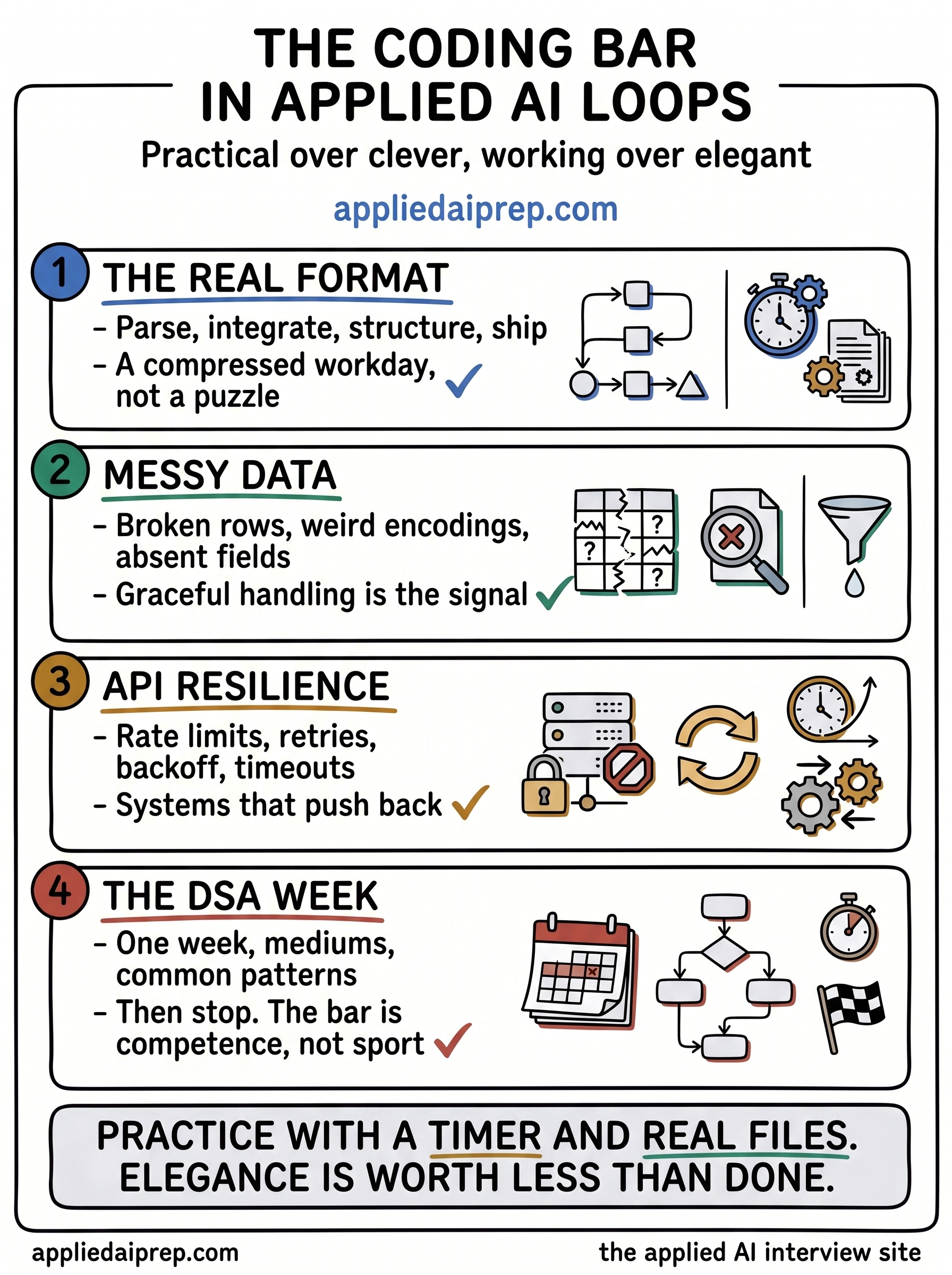
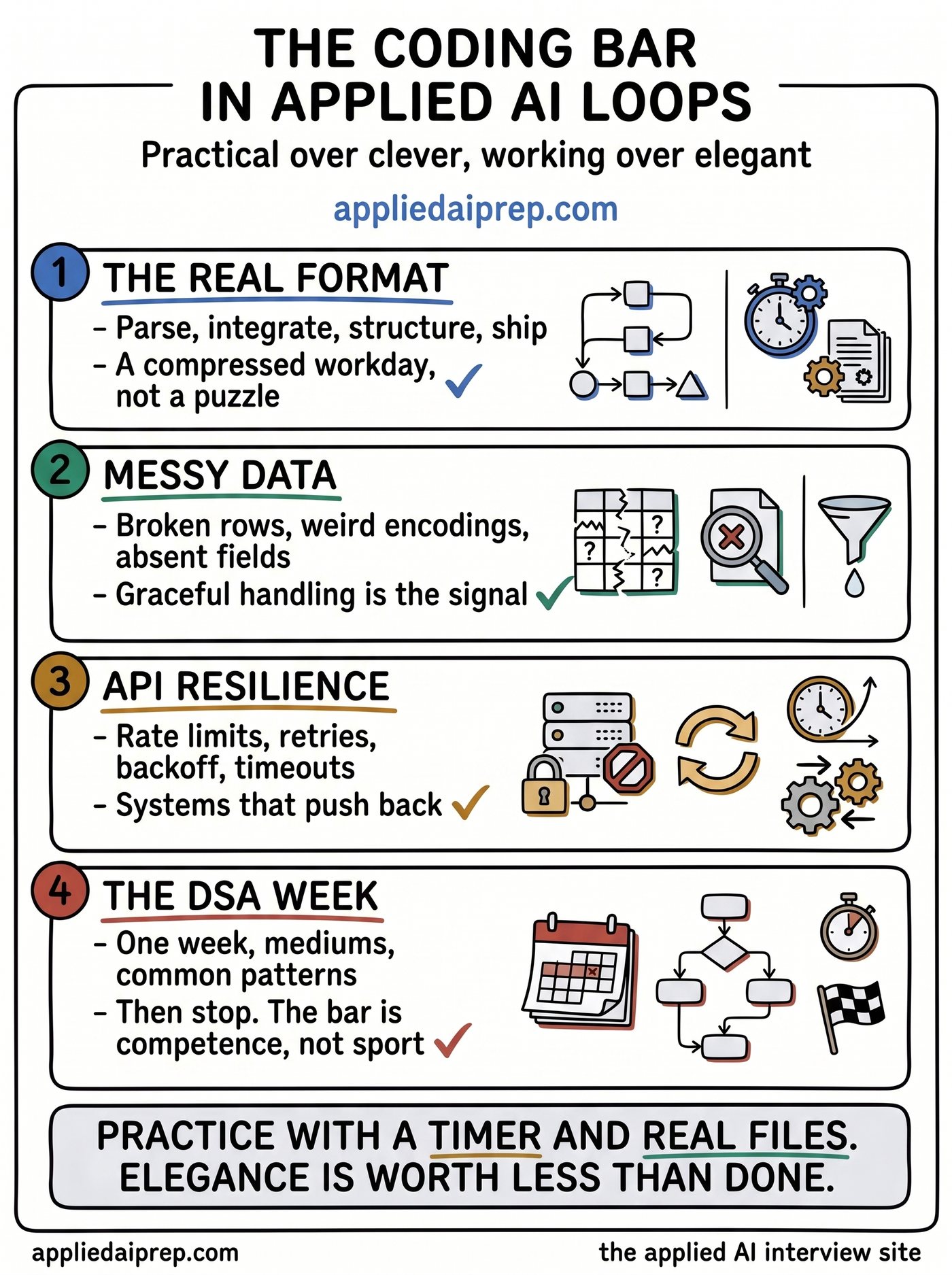
Practical builds (parsers, in-memory stores, rate limiters, streaming) plus the LeetCode-medium staples, calibrated to the practical coding screens applied AI teams actually run.
Grounded in real Applied AI Engineer interview loops and written to a senior-engineer editorial bar.
You have 10 free answers unlocked here.Sign in free for 10 more · 111 are premium.
COURSES COVERING THIS TOPIC
Structured lessons that teach this material from the beginning, rather than testing it.
01–53Foundationsthe vocabulary every loop assumes you already have0/53 done
54–99Core loopsthe questions every loop actually asks0/46 done
100–131Field scenariosthe messy, half-specified problems from real deployments0/32 done
The concepts behind Coding & DSA
The vocabulary and mental models these questions assume, from our curriculum. Start with the foundations free; the deeper, interview-defining ideas are part of premium.
Foundational
Parsing Messy Real-World Data: Defensive Parsing PatternsHow to read malformed input: validate, decide per record whether to skip, default, or fail, and keep one bad row from killing the whole batch.Foundational
The Big-O That Actually MattersBig-O complexity matters most where it bites in real AI systems: avoid accidental O(n^2) (all-pairs comparisons, repeated linear scans), use hash maps for O(1) lookups, and know that vector search is approximate precisely because exact nearest-neighbor is O(n) per query. The practical skill is spotting the quadratic trap and the data-structure fix, not reciting complexity classes. Applied-AI interviews probe it because the difference between O(n) and O(n^2) is the difference between a system that scales and one that falls over.Core
Testable Design for AI SystemsAI systems are hard to test because models are non-deterministic and call external services, so testability has to be designed in: isolate the non-deterministic model behind an interface so you can mock it, separate deterministic logic (parsing, retrieval, formatting) from the model call and test it normally, and assert on metric tolerances rather than exact outputs. Applied-AI interviews probe it because untestable LLM code regresses silently, and the discipline of mocking the model and testing the deterministic parts is what keeps a system reliable.Sign in
Core
Streaming and BackpressureWhen data is too big to fit in memory or arrives continuously, you process it as a stream, one piece at a time, with bounded memory, rather than loading it all. Backpressure is the mechanism that stops a fast producer from overwhelming a slow consumer, by signaling 'slow down' rather than buffering unboundedly until you run out of memory. Applied-AI interviews probe it because AI pipelines process huge datasets and token streams, and the naive load-everything approach OOMs while unbounded buffering crashes under load.Sign in
Foundational
Arrays and HashingThe hash map is the workhorse of coding interviews: average O(1) insert and lookup that turns an O(n^2) all-pairs scan into a single O(n) pass. The recurring moves are the seen-set (remember what you have passed) and frequency counting (tally then read back). Applied-AI interviews probe it because most array problems are really hash-map problems in disguise, and the candidate who reaches for the dictionary first signals real fluency.Foundational
Two Pointers and Sliding Window: O(n) Array PatternsConverging pointers on a sorted array, and an expanding-contracting window with a running invariant. The two moves that replace an O(n^2) nested scan.Foundational
Binary Search: Off-by-One Templates and Search on the AnswerThe lo/hi/mid loop without the off-by-one bugs, plus the harder skill: spotting a secretly monotonic problem and binary-searching the answer, not an array.Foundational
Linked Lists: Dummy Head, Fast/Slow Pointers, ReversalThe three patterns interviews actually test: the dummy head that removes edge cases, fast/slow pointers for cycles and midpoints, and in-place reversal.THE ONE-PAGE VERSIONDownload ↓