Applied AI Engineer vs Solutions Engineer, Sales Engineer & ML Engineer
How the Applied AI Engineer role differs from solutions engineers, sales engineers, applied AI engineers, customer success engineers, and consultants — by lifecycle stage, mandate, and how much you code.
7 MIN READ · UPDATED 12 JULY 2026
The one distinction that explains all the others
Every adjacent role can be placed on two axes: where it sits in the customer lifecycle, and how much production code it writes. The Applied AI is the role that sits post-sale, in production, and codes most of the week while owning the outcome. Hold that fixed and the rest fall into place.
Applied AI vs Solutions Engineer / Solutions Architect
Solutions engineers and architects live mostly in the late pre-sale and early post-sale window. Their mandate is to map product capabilities to a customer's requirements and design the solution — demos, proofs-of-concept, advisory. They code, but mainly for PoCs, and they're rewarded for design and advice rather than operational ownership. The Applied AI builds what doesn't exist yet and keeps it running; the SE sells and designs the vision of what could exist.
Applied AI vs Sales Engineer
A sales engineer is pre-sale and sales-first: provide the technical validation that closes the deal, then move to the next opportunity. Coding is light. The Applied AI picks up after the deal and is measured on whether the thing actually works in production months later.
Applied AI vs Applied AI Engineer
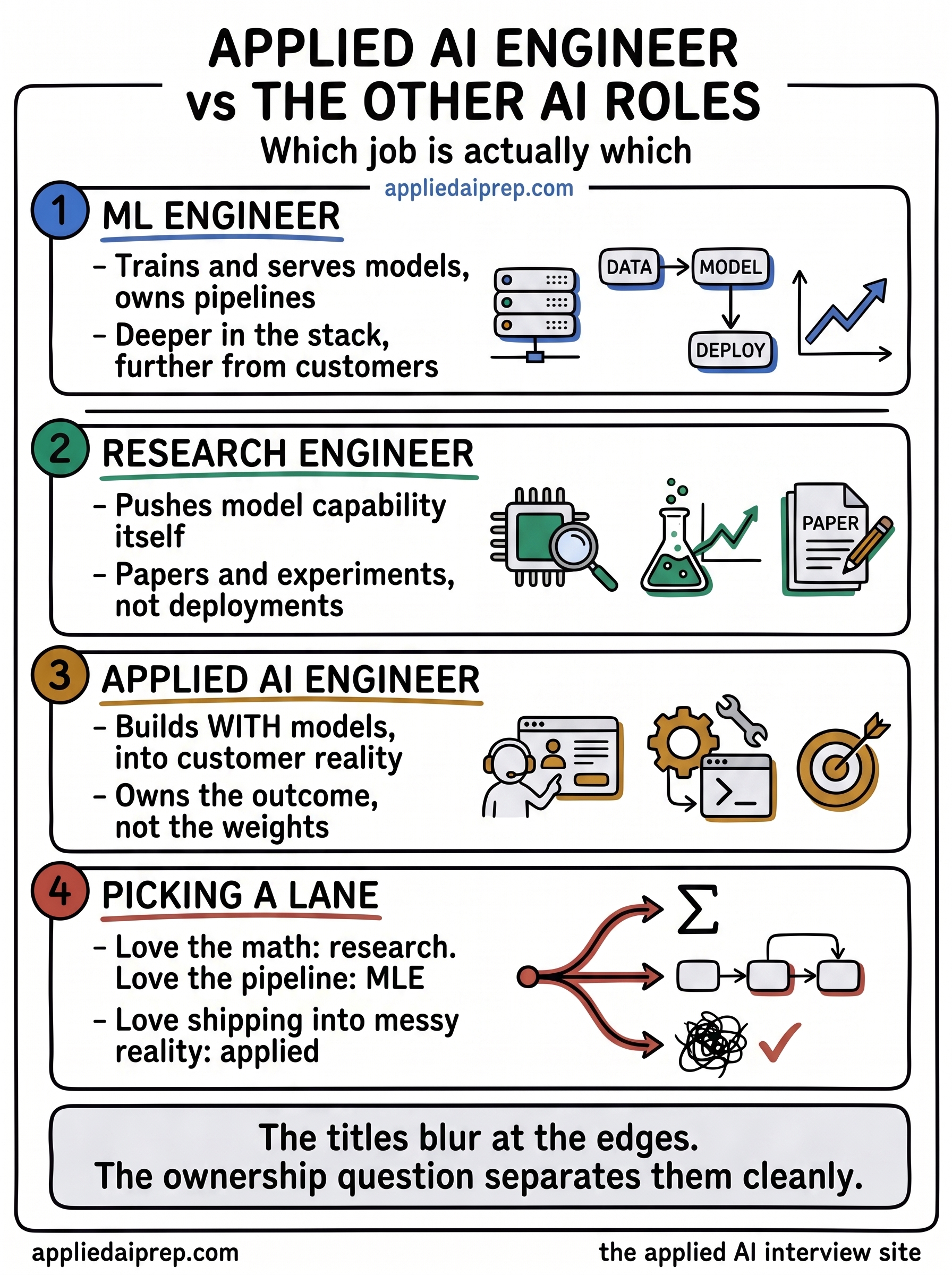
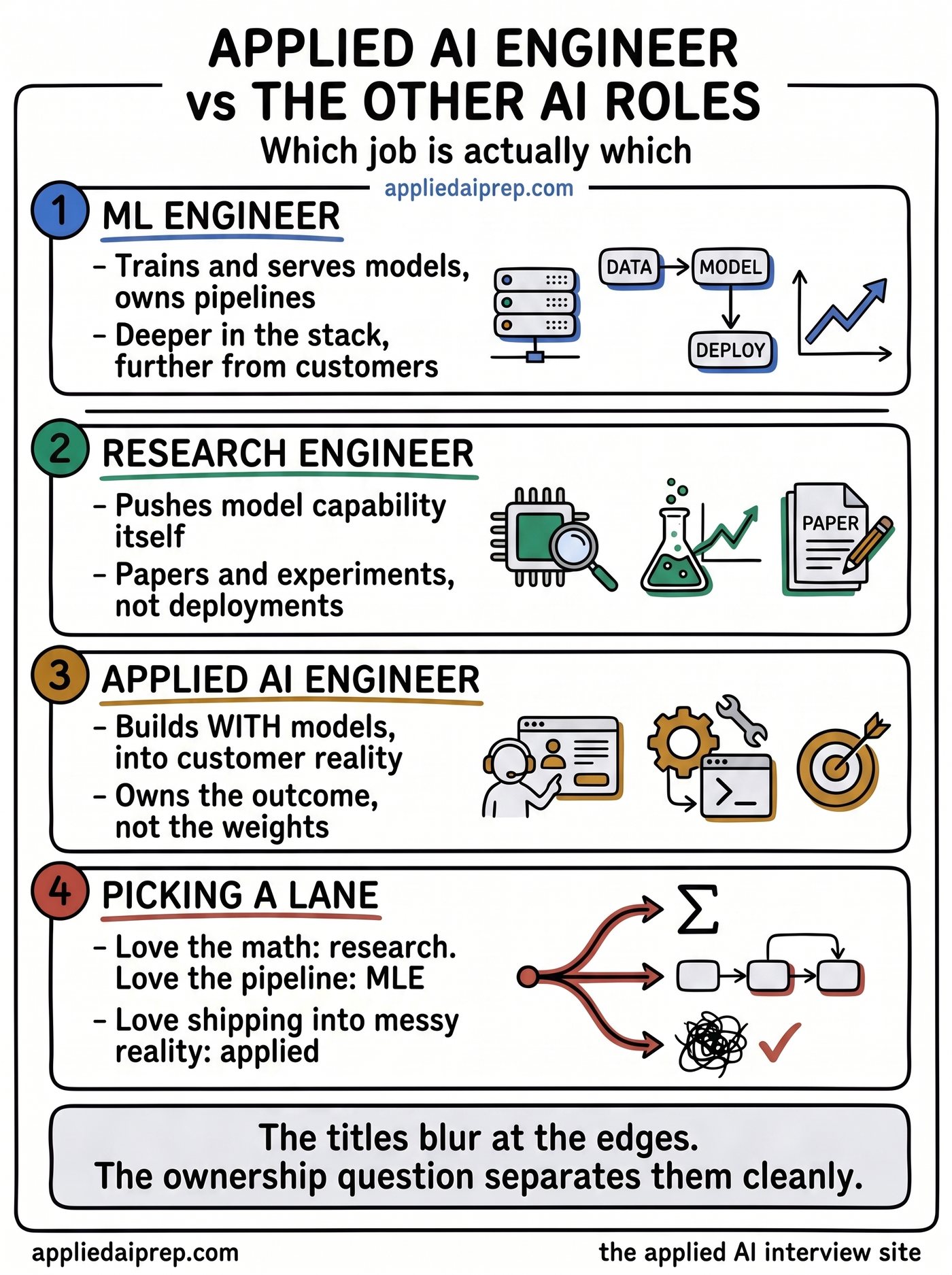
These are largely the same role under different titles. "Applied AI Engineer" (Palantir, OpenAI) tends to emphasize integration and deployment depth; "Applied AI Engineer" (Anthropic and many AI startups) tends to emphasize AI quality and evaluation rigor. Both embed with customers and ship production AI. If you're choosing between postings, read the responsibilities, not the title.
Applied AI vs Customer Success Engineer & Consultant
A customer success / customer engineer works post-go-live to protect and expand the account — onboarding, troubleshooting, ongoing support. The framing that sticks: Applied AI engineers accelerate getting to production; CS engineers protect and expand once you're there.
A professional-services consultant installs and configures software and makes one-off recommendations, often independent of product engineering. The Applied AI works with a customer long-term and routes insights back into the product, so a field solution can become a feature the whole user base benefits from — the opposite of a one-off customization.
Turn the theory into offers — work the question topics this maps to:
FAQ
A solutions engineer designs and advises, mostly around the sale, and codes mainly for PoCs. An Applied AI works post-sale, writes production code most of the week, and owns whether the deployment actually works.