Applied AI Skills: What's Tested and What Makes a Great One
The technical and customer-facing skills Applied AI Engineer interviews test in 2026, what separates a great Applied AI from an average one, and how to break into the role.
8 MIN READ · UPDATED 12 JULY 2026
The technical stack interviews actually screen for
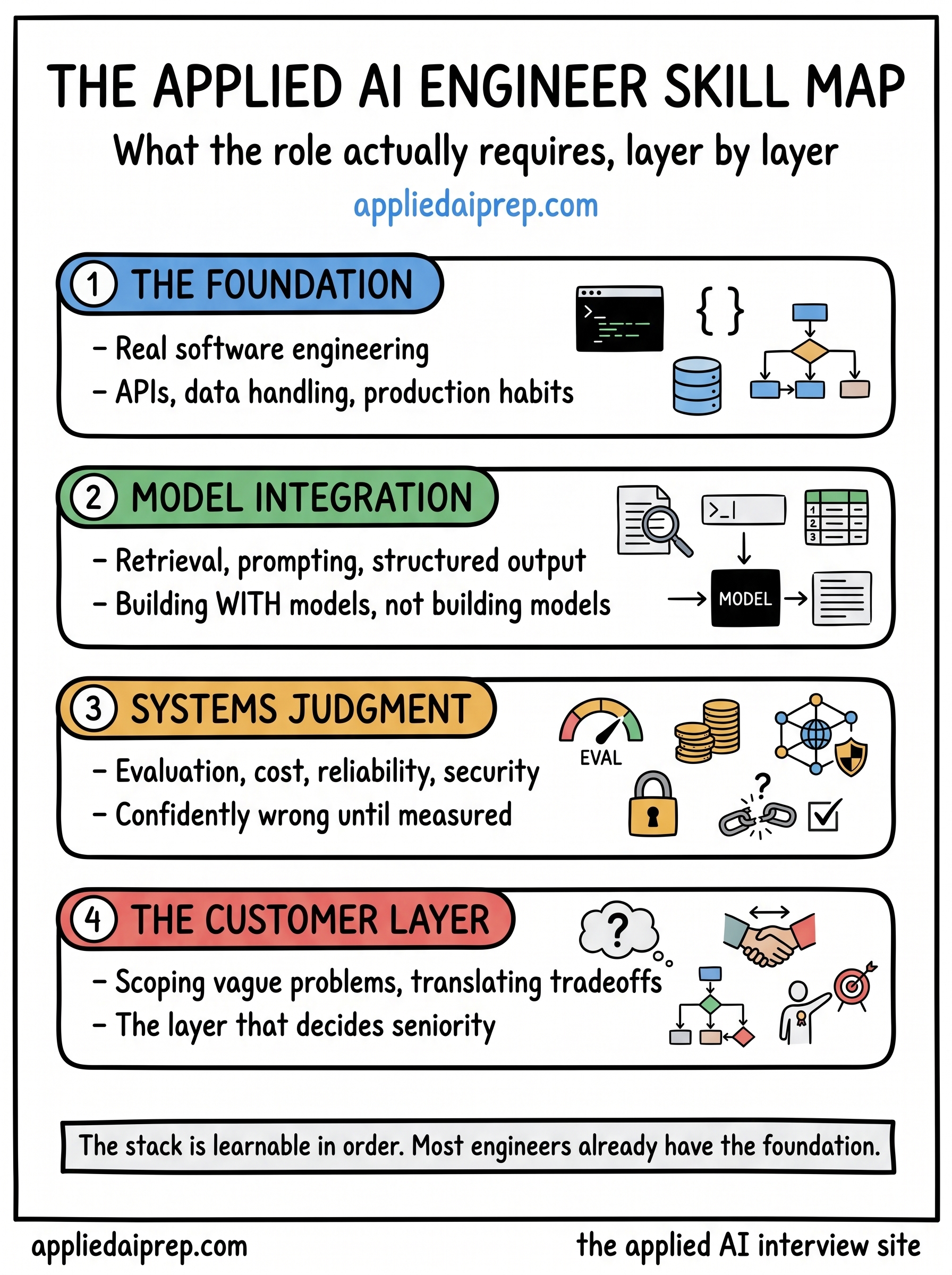
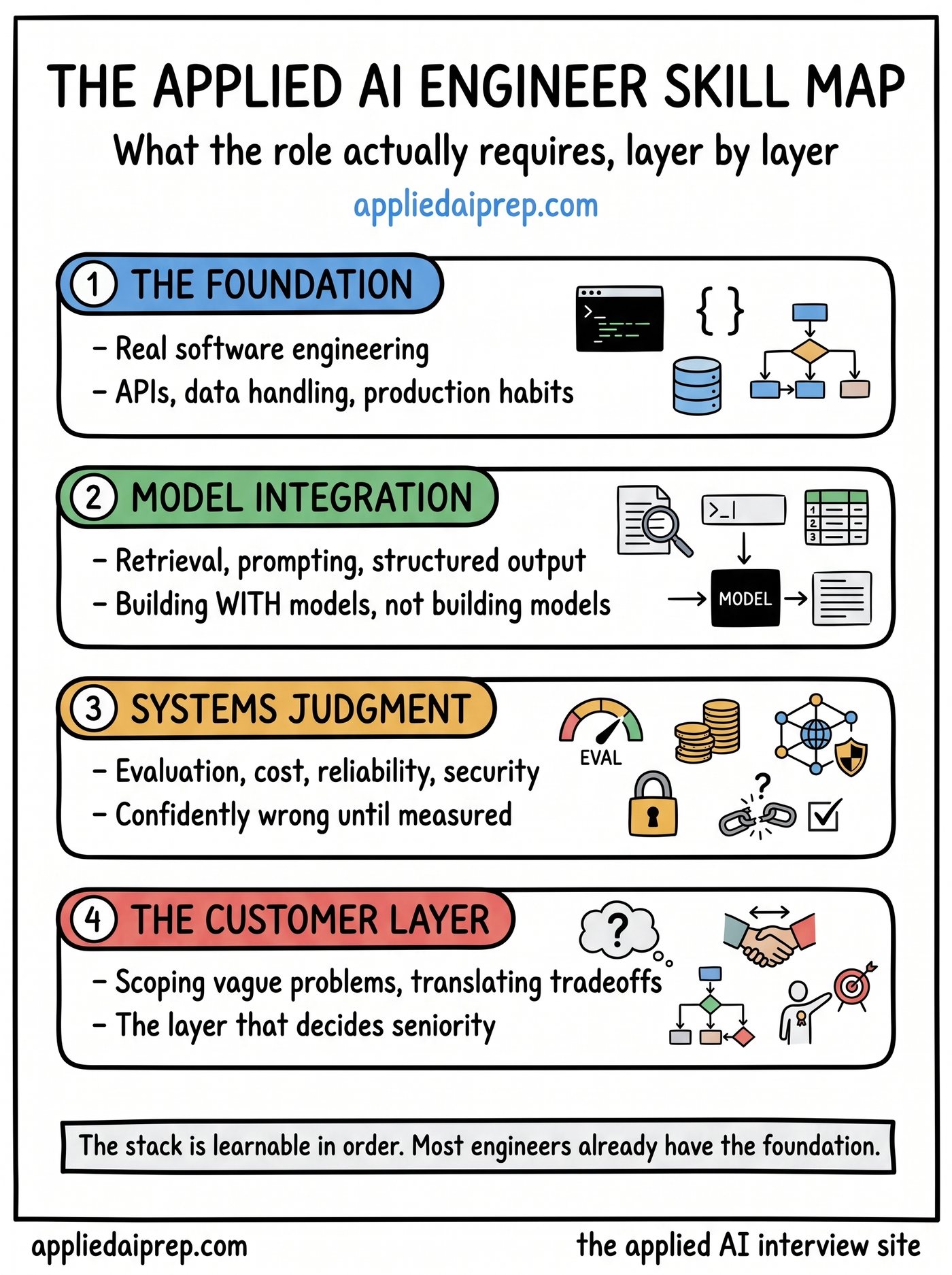
An analysis of roughly a thousand Applied AI postings put the most-requested skills at Python (about two-thirds of roles), then AI agents, TypeScript, AWS, and LLMs (each around a third). Underneath those headline skills sits a recognizable AI-engineering stack: retrieval-augmented generation, vector databases (Pinecone, Weaviate, pgvector), LLM APIs, agent orchestration (LangChain, LlamaIndex, LangGraph), prompt engineering, and fine-tuning.
Two adjacent competencies show up constantly and trip people up: SQL and the modern data stack (Snowflake, BigQuery, Databricks), because real deployments live or die on the customer's data; and API integration (REST, GraphQL, auth protocols), because the agent is only as useful as the systems you can connect it to.
And the differentiator for AI Applied AI engineers specifically: evaluation. Not opinions about whether the system is good — a real eval harness, a golden set, and the discipline to measure before changing anything.
The customer-facing half people underrate
The other half of the job is genuinely a skill, not a personality trait: requirements discovery (finding the real problem behind a vague ask), stakeholder management across the analyst-to-CTO range, negotiating architectural constraints with non-technical people, and driving adoption through iteration rather than a big-bang launch.
Interviewers look for a "T-shaped" profile: deep expertise in at least one core technical area, broad capability across several, and a strong vertical bar of customer judgment. The client-simulation round — present a solution to a role-played customer — is weighted heavily for exactly this reason. At some labs that single round reportedly filters the majority of candidates who already cleared the coding stages.
What separates a great Applied AI from an average one
It is not algorithmic speed. The great Applied AI scopes the right problem, proves the system works with numbers rather than vibes, and communicates well enough to drive adoption. The recurring industry line is that it's far easier to teach an engineer to talk to customers than to teach a salesperson to write production code — so the best Applied AI engineers are engineers who deliberately built customer-facing judgment most engineers avoid.
Concretely, the great ones answer "how do you know your AI system is actually working?" with a real measurement strategy; they argue against the fancy solution when a simpler one fits; and they treat idempotency, rollback, and observability as non-negotiable rather than nice-to-have.
How to break in
The most common path is a software engineer who develops customer-facing skills. Practically: learn the AI-engineering stack end to end (LLM orchestration, RAG, evals, agent frameworks, vector stores); build something real with messy data and a genuine integration, not a toy demo; and get deliberate reps at the customer-facing work — explaining trade-offs, scoping ambiguous problems, presenting under pushback.
Then prepare for the loop specifically, because it tests an unusual blend. Practical coding, real-world system design that shifts requirements mid-round, an open-ended decomposition, and a customer role-play are all standard — and they reward different muscles than a classic algorithm-heavy SWE loop.
Turn the theory into offers — work the question topics this maps to:
FAQ
Strong Python (and often TypeScript), the AI-engineering stack (RAG, agents, LLM APIs, vector DBs, evals), SQL and data fluency, API integration, plus real customer-facing skills: discovery, stakeholder management, and driving adoption.