
From Prompter to System Builder: the Shift Applied AI Interviews Actually Test
A 30-month, $3M experiment ran AI agents on 1,287 real engineering tasks and found the gains came from the loops and guardrails, not the model. That shift, from prompter to system builder, is exactly what Applied AI interviews test. Here is how to show it.
BY MEI LIN · APPLIEDAIPREP EDITORIAL · UPDATED JULY 25, 2026 · 8 MIN READ
The shift from prompter to system builder is the single thing most Applied AI interviews are built to detect, and you can show it in one sentence. A prompter, asked to build something, reaches for a better instruction to the model. A system builder reaches for a loop: what goes in, how it is processed, the exact shape of the output, how that output gets checked, and what happens when it fails. The interviewer usually knows you can write a decent prompt. The rounds are spent finding out whether you can build the reliable system around it, because that is the actual job. This post covers what the shift looks like in practice, and how to demonstrate it in the interview loop.
The framing has been making the rounds lately as "loop engineering," aimed mostly at creators and solo operators. The underlying idea is older than the name and maps almost exactly onto what a strong Applied AI Engineer does daily. Here is the version that matters when someone is deciding whether to hire you.
What a $3 million agent study found
A 2026 independent technical report put hard numbers on the same idea, under the same name. Over 30 months and about $3.08 million, its authors ran AI agents against 1,287 real engineering tasks across 12 production codebases, roughly 2.4 million lines of code added or changed, and compared the results to historical human baselines on the same repositories and task mix.
The reported figures are worth sitting with, read as the report's own results rather than settled fact:
| Metric | Reported figure |
|---|---|
| Scope | 1,287 tasks across 12 production codebases, about 2.4M lines changed |
| Duration and cost | 30 months, roughly $3.08M total |
| End-to-end completion, no human | 59.4% (human baseline on the same work: 42.0%) |
| Median cycle-time reduction | 41.7% |
| Post-review defects | 0.73 per KLOC (reported mid-level human rate: 0.68) |
| Routine activity automation | 63% |
| Rework reduction | 24% |
The report is independent and not peer reviewed, so treat the numbers as directional. What matters for this article is where the authors put the gains: the agents multiplied output only when wrapped in the right memory, the right loops, and the right guardrails, not when handed a bigger model. In their framing, the loop is the product. That is the same thing every good interviewer is testing for, and it is why the shift below is worth the work.
What the interviewer is actually sorting for
Every open-ended prompt in a case-study or design round is a sorting mechanism. "How would you build X" has two kinds of answers, and they separate candidates cleanly.
The prompter answer stays at the level of the model: a sharper instruction, a better example, a longer context. It can be genuinely good and still lose, because it treats the model as the system.
The system builder answer treats the model as one component in a loop that has an input, a process, an output contract, a verification step, and a failure path. That answer survives the follow-up questions, because the interviewer's whole job in the next ten minutes is to break your design, and a bare prompt has nothing to push on.
You do not need all of the moves below in every answer. You need the reflex to reach for the loop instead of the prompt.
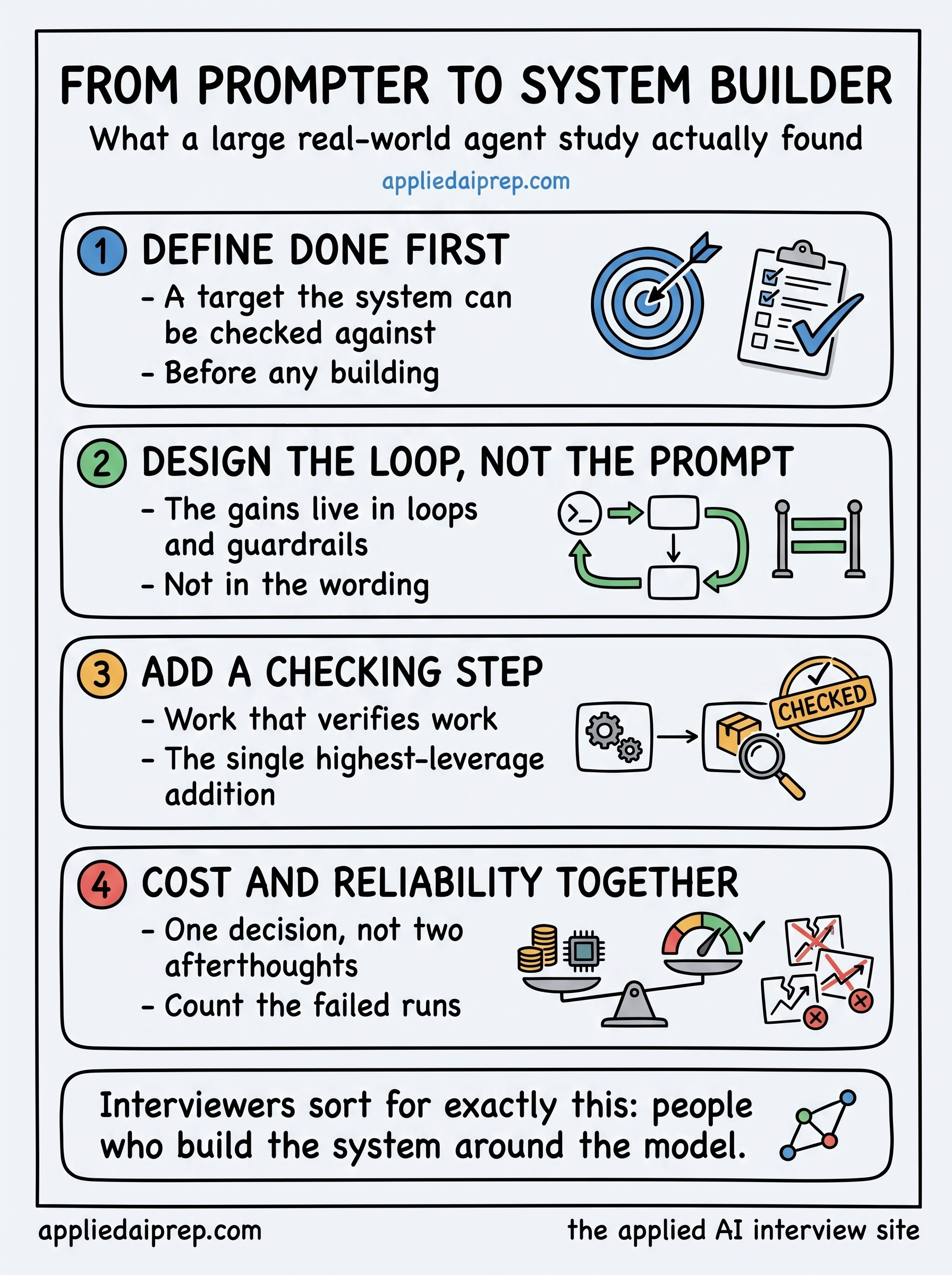
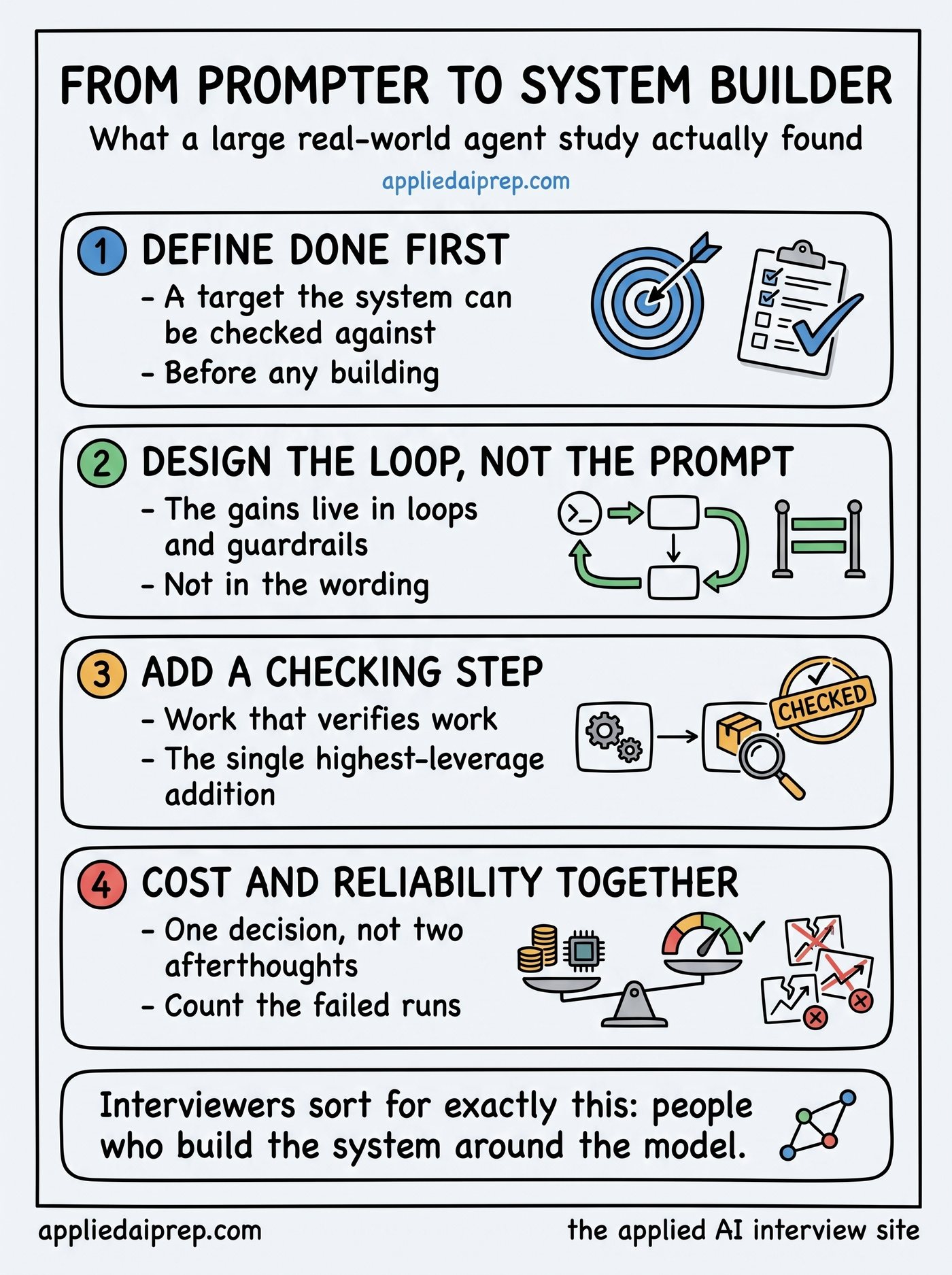
Define "done" before you build
Most weak answers fail on a fuzzy goal. "Write a good summary" or "help the customer" leaves the model guessing what to aim for and leaves you with no way to tell if it worked.
The system builder states success criteria first: what the output must contain, what it must never do, and when to stop. That single habit is what makes evals possible later, because you cannot measure against a target you never wrote down. In an interview, saying "before I build this, here is what a correct output looks like and here is the one failure I care most about avoiding" signals more seniority than any model trick. It is also the honest version of the work: real deployments live or die on whether "done" was defined sharply enough to test.
Design the whole loop, not the prompt
A single prompt is a task. A loop is a system: input, process, output format, a review of that output, and a note on what to improve next time. Naming those parts out loud is most of the battle.
Take a document-processing example. The input is a batch of PDFs. The process is retrieval plus extraction. The output is a fixed schema, not free text. The review is a check that the extracted fields are internally consistent. The improvement is logging the cases the check flagged so the next version handles them. That is the same structure whether the domain is contracts, support tickets, or clinical notes, which is exactly why interviewers reward it: it shows the structure transfers. Our RAG and agent questions are largely drills on getting this loop right under pressure.
Add a step that checks the work
The upgrade that most separates the two mindsets is refusing to trust the first output. A system builder adds a second pass: the same model in a critic role, or a cheaper model, or a deterministic check, reviewing the draft against the success criteria before anything ships.
This is not academic. On anything a customer sees, a wrong figure or a fabricated citation costs more than the extra call to catch it. The math is blunt: six sequential model steps at 98 percent reliability each land near 89 percent end to end, so a system with no check quietly ships the 11 percent. Candidates who mention the verification layer unprompted read as people who have shipped something that broke once and learned from it.
Split the work into roles
Early answers try to do everything in one giant prompt: research, write, critique, format. It can work and it is hard to control. The system builder splits the work so each step has one job. A researcher step gathers and structures. A writer step turns that into the output. A critic step finds the gaps. Each is easier to test and easier to fix in isolation.
This is the honest, small version of the multi-agent design questions that show up in senior loops, and it connects directly to the system-design round, where the interviewer wants to see you decompose a fuzzy problem into components with clear contracts between them.
Treat cost and reliability as one decision
Not every task deserves your most expensive model at maximum reasoning. A system builder routes: classify the task, send the easy majority to a cheap fast path, reserve the deep model for the hard minority. Reasoning about that split out loud is a strong signal, because it forces you to hold cost, latency, and quality in one decision instead of pretending they are separate. Most candidates who have only ever run one model at full settings cannot do it convincingly, and it shows.
Treat the good ones as infrastructure
The last piece is mindset. A prompter runs a loop, it works, and next week they rebuild it from memory. A system builder writes down the loops that work (the input, the steps, the success criteria, the known failure points) so they become reusable assets with continuity and, where it earns its keep, a trigger that runs them on a schedule. This is the difference between owning a workflow and re-improvising it, and it is what "owns the deployment" actually means on the job. The related mindset gap between shipping code and owning an outcome is the same one we cover in Applied AI Engineer vs Software Engineer.
How to practice the shift
You do not build this reflex by reading about it. Take one workflow you already run by hand and rewrite it as a loop on paper: input, process, output contract, the check on the output, and what you would log. Do that for three or four real tasks and your default answer changes, because the structure becomes automatic. Then pressure-test it against real questions. The must-know Applied AI set is built to force the loop out of you, and the broader skills reference maps where each move fits in the role.
The one-line version: a prompter improves the instruction, a system builder builds the loop around it. Interviews are designed to tell them apart, so answer as the second one.
Turn it into offers. Work the real questions and concepts this maps to:
FAQ
Yes, but as one skill inside a larger job, not the job itself. A strong prompt is table stakes. What gets you hired is turning that prompt into a system with clear success criteria, a verification step, and a way to run and monitor it in production. Interviewers assume you can write a good prompt and spend their time probing whether you can build the loop around it.
Discussion (4)
The fastest tell I use when screening: I ask how they would build a summarizer, and I listen for the second sentence. 'I would prompt it to be concise' is a prompter. 'I would define what a good summary contains, then have a second pass check the draft against that list' is a system builder. Same person can give either answer depending on whether they have made the shift.
This lands for me. When I moved from scripts to owning a deployment, the change was not writing better prompts, it was that I stopped trusting the first output on anything a customer would see. The critic pass felt like overkill until the week it caught a wrong number before the customer did.
Worth adding: the routing point (cheap model for the easy 80 percent, expensive model for the hard 20 percent) is where a lot of candidates either shine or reveal they have only ever run one model at max settings. Interviewers love it because it forces you to reason about cost and reliability as one decision instead of two.
One caution so this does not tip into over-engineering: not every task needs a five-stage loop with memory and a scheduler. The senior move is knowing which workflows deserve the full system and which are genuinely one-shot. Building infrastructure around a task you run twice is its own kind of junior answer.