What is an Applied AI Engineer?
An Applied AI Engineer embeds with a customer to make a vendor's software actually work in production. Here's where the role came from, why AI labs are hiring Applied AI engineers in 2026, and what makes it different.
7 MIN READ · UPDATED 12 JULY 2026
The short definition
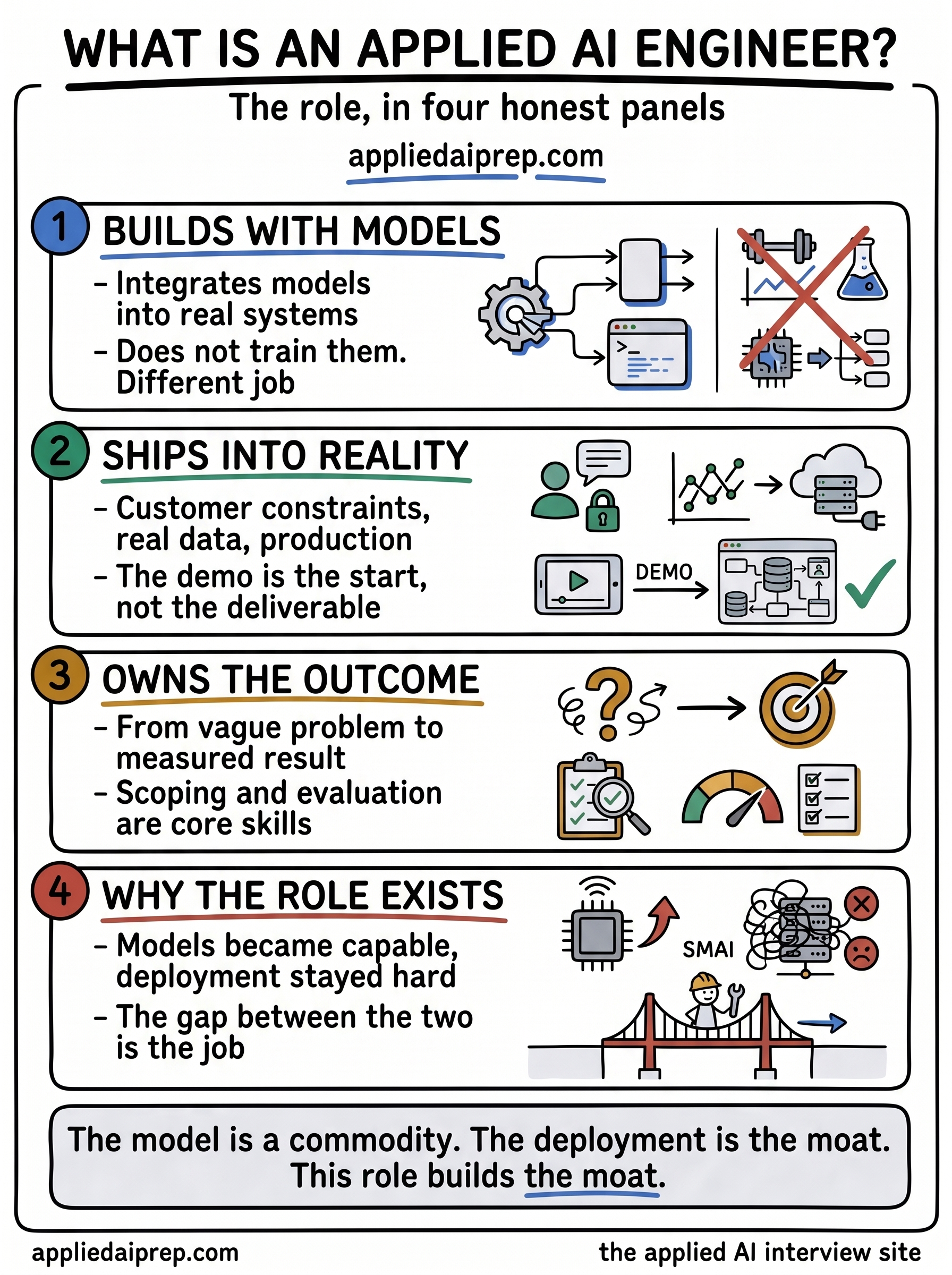
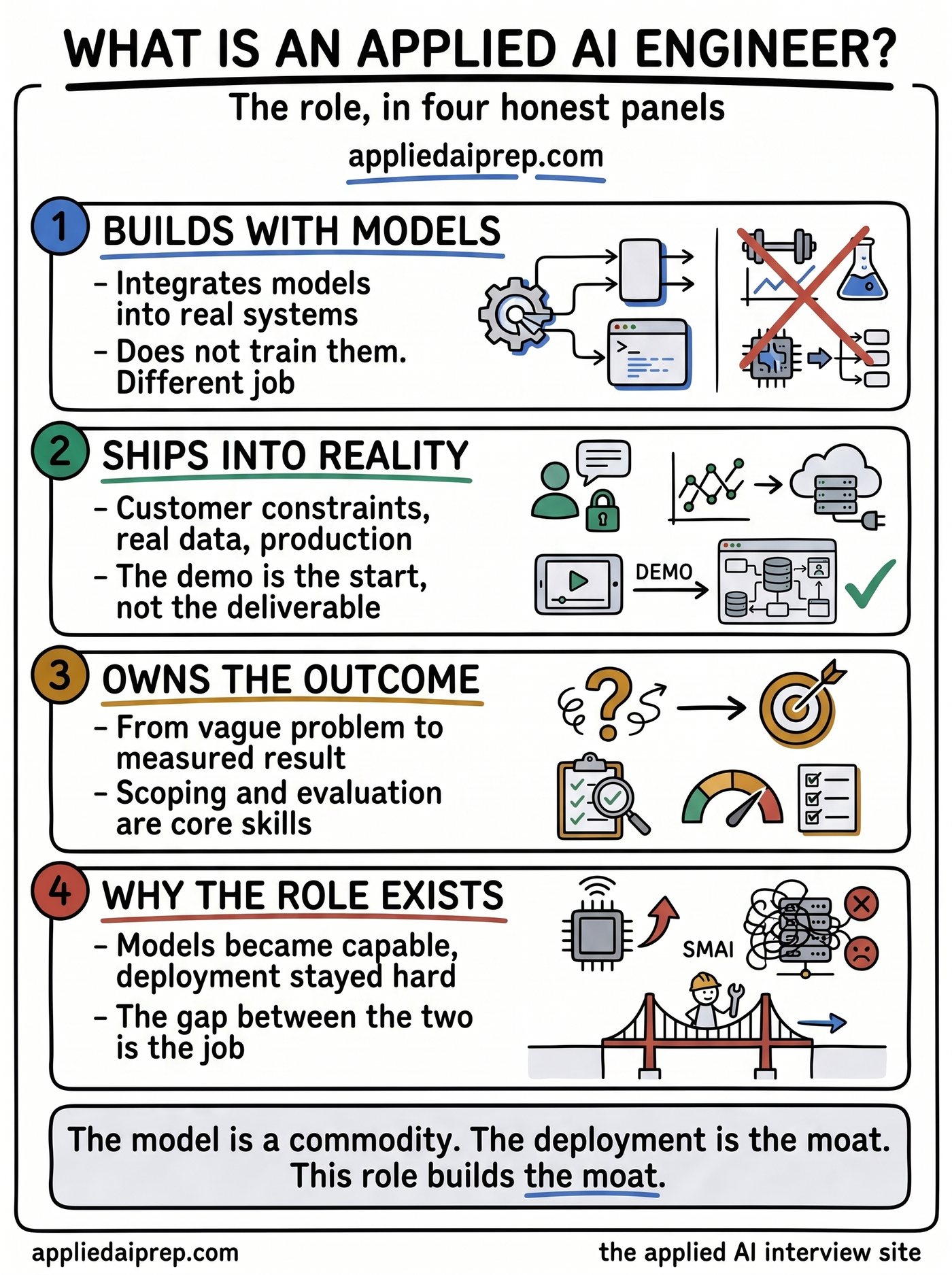
An Applied AI Engineer is a software engineer who embeds directly with a customer to make a vendor's product work inside that customer's real environment — building the integrations, workflows, and production systems that turn a powerful-but-raw platform into a measurable business outcome.
The usual shorthand is "half engineer, half consultant, full owner." Unlike a pre-sales role, an Applied AI writes production code most of the week. Unlike a core product engineer, the Applied AI engineer does it inside one customer's messy, regulated, legacy-laden systems rather than in a clean internal codebase. The role exists when a product is powerful but not yet obvious, and the customer needs hands-on engineering to extract its value.
Where the role came from: Palantir's "Deltas"
Palantir created the role in the early 2010s and called it the "Delta" — a Forward Deployed Software Engineer (FDSE). The name is a relic of Palantir's early naming convention, where each Business Development team took a NATO-alphabet letter. Tellingly, Deltas sat in Business Development, not Product Development.
Palantir's own framing is the cleanest way to understand the split: a Dev (product engineer) is "one capability, many customers," while a Delta is "one customer, many capabilities." The Dev builds the platform; the Delta embeds with a single customer and bends that platform to their problem. For a stretch of its early history, Palantir had more Deltas than Devs.
The role was a response to intelligence and defense customers who often could not even describe their needs through normal product discovery. They didn't need more features — they needed engineers who could make the product work inside fragmented, sensitive, politically complex environments.
Why the role exploded across AI labs in 2025–2026
The Applied AI model migrated to frontier AI labs because deployment, not model quality, is where enterprise AI fails. A widely-cited 2025 MIT study found roughly 95% of enterprise AI pilots produced no measurable P&L impact — and the failures traced overwhelmingly to deployment and integration, not to the underlying models.
That gap is exactly what an Applied AI closes: the bridge between a capable model and a working production outcome inside a specific company. Reported job-posting volume for the role rose more than 800% between January and September 2025, and by 2026 most billion-dollar AI companies run an Applied AI function of anywhere from 20 to 200 engineers.
The headline 2026 signal: OpenAI launched a dedicated, multi-billion-dollar deployment company whose engineers don't sell software but sit inside enterprises and build the systems that make the software produce outcomes. Anthropic hires the same role under the "Applied AI Engineer" banner, and Google Cloud has been hiring forward deployed engineers for Gemini and Vertex AI at scale.
What an Applied AI is not
An Applied AI is not a salesperson, not a pure consultant, and not a help-desk. Sales engineers validate technology to close a deal and then move on; consultants make one-off recommendations; support engineers protect an account after go-live. The Applied AI's distinguishing trait is operational ownership: they build what doesn't exist yet, get it into production, and stay accountable for whether it actually works.
Turn the theory into offers — work the question topics this maps to:
FAQ
It's an engineering role. Applied AI engineers write production code most of the week; the difference from a normal SWE is that they build inside a customer's environment and own the outcome, which adds heavy customer-facing work on top of the engineering.