What Does an Applied AI Engineer Actually Do?
A day-in-the-life look at the Applied AI Engineer role: the deployment lifecycle, real deliverables, how success is measured, and how much you actually travel.
8 MIN READ · UPDATED 12 JULY 2026
A representative day
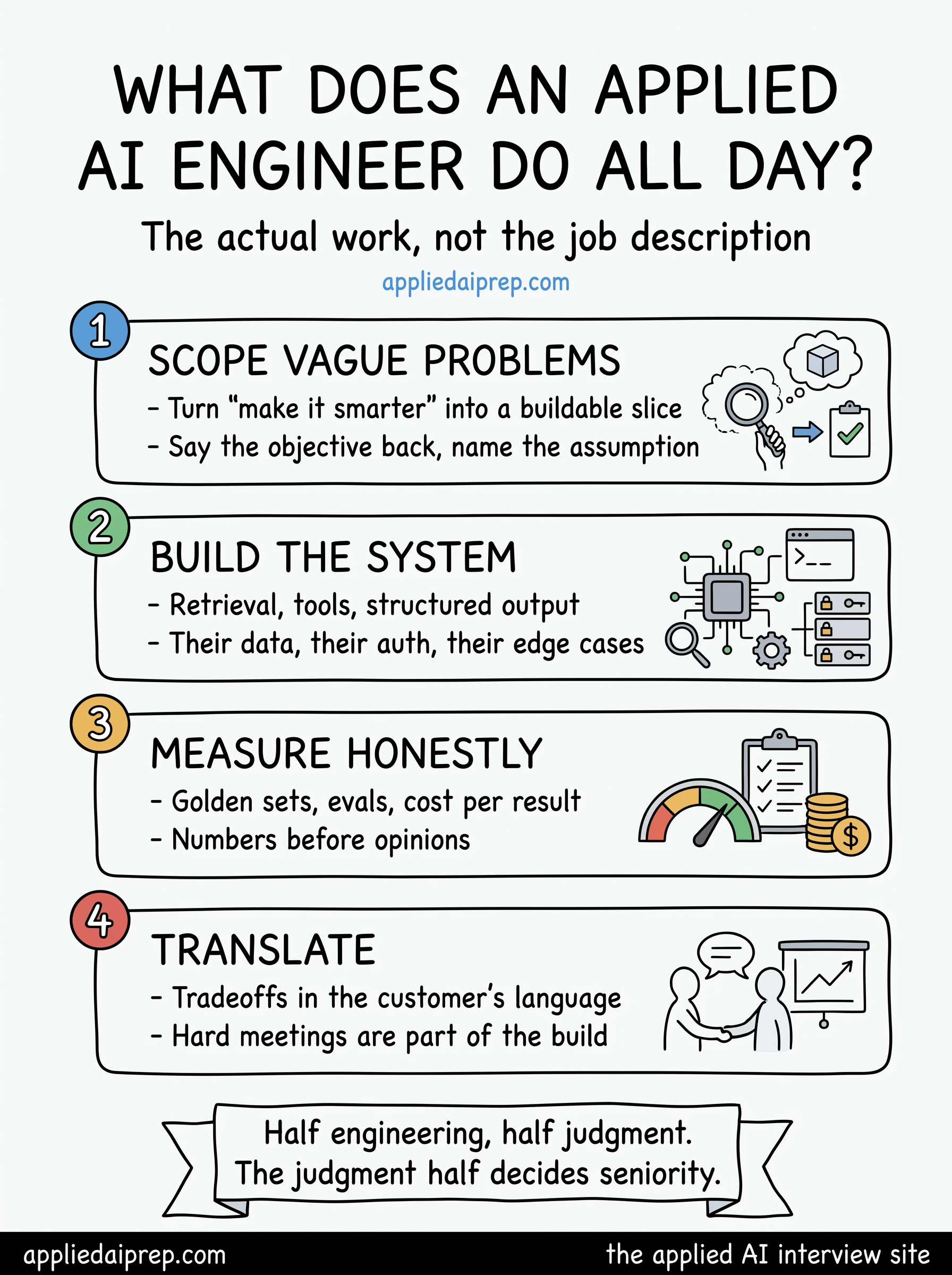
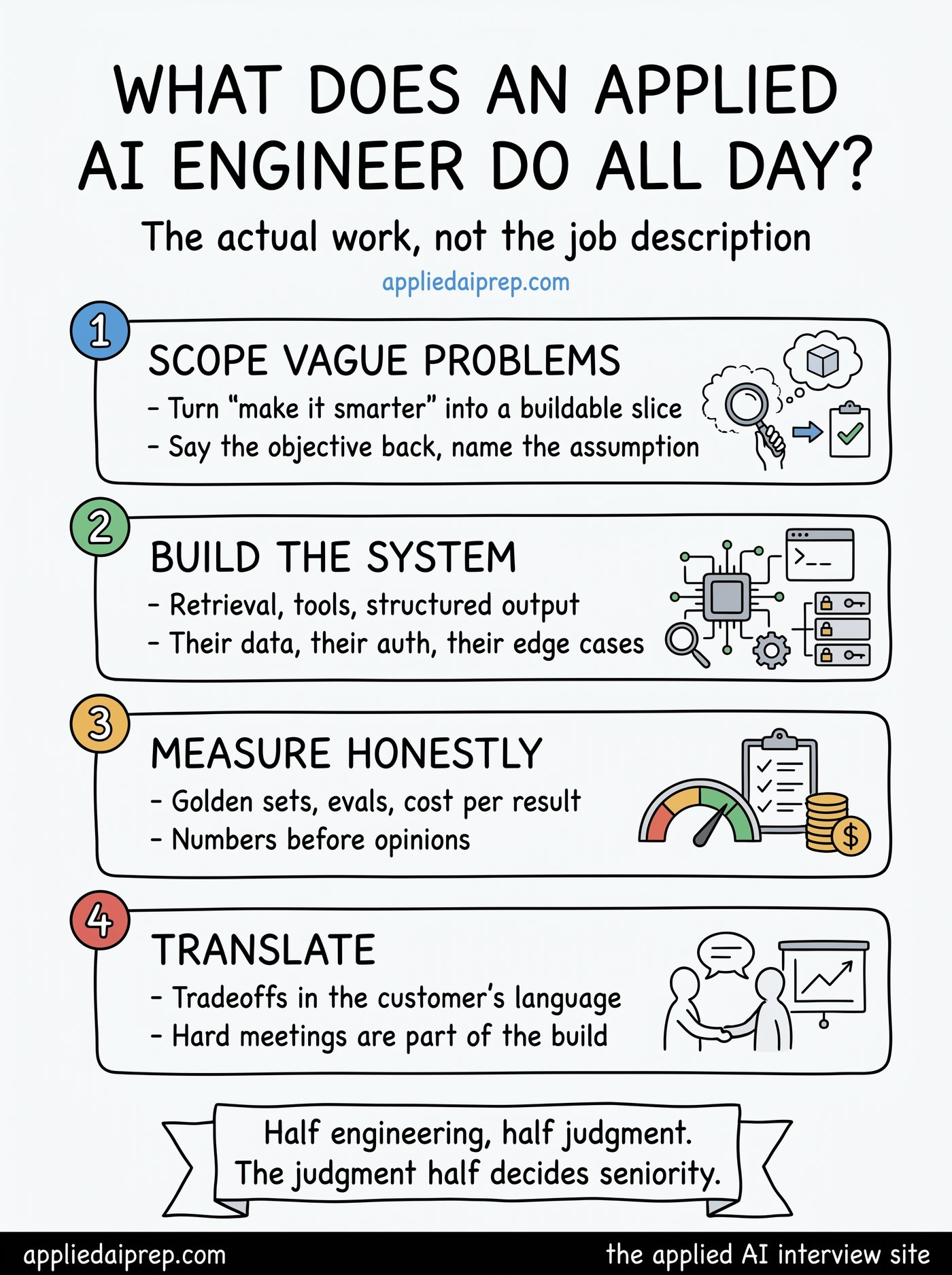
A typical Applied AI day swings between two modes. In the morning you might be deep in code — debugging why a retrieval pipeline degraded after the customer's nightly data refresh, or wiring an agent into a legacy ticketing API that has no clean documentation. By the afternoon you're in a room (or a video call) with the customer's stakeholders, explaining an implementation trade-off to people who range from line-level analysts to a skeptical CTO.
That oscillation — build, then translate, then build again — is the job. The engineers who thrive treat the customer conversation as part of the engineering, not an interruption to it.
The deployment lifecycle you own
Applied AI engineers own the whole arc, not a single stage: scoping and discovery, prototyping a proof-of-value, integrating with the customer's systems, hardening to production, and then handing off something the customer can operate. In practice that means requirements analysis, solution design, implementation, system integration, deployment, and post-go-live stabilization.
Scoping is where good Applied AI engineers separate from average ones. The skill is interrogating a vague request to find the problem that actually matters and the real constraints behind it — then choosing an architecture deliberately (RAG versus fine-tuning, the embedding and chunking strategy, the agent's tool-calling boundaries, how it integrates with what already exists).
Hardening is where the work gets unglamorous and essential: idempotency, observability, runbooks, and the monitoring that lets the customer run the system without you. A pilot that works in a notebook is not a deliverable; a system the customer trusts in production is.
Real deliverables
Concretely, Applied AI engineers ship: working pilots and proofs-of-value; production deployments; custom integrations and workflows tailored to the customer's stack; monitoring, observability, and runbooks so the customer can self-operate; and reusable frameworks that get abstracted back into the core product so the next customer is easier.
That last one matters more than it looks. The best Applied AI engineers feed field insights back to product and business teams, so a solution built once in the field becomes a feature that benefits every customer — the difference between an Applied AI and a one-off consultant.
How success is measured
For product-company Applied AI engineers, success is not engineering velocity — it's whether the system produces reliable work in production and whether the customer actually adopts it. The metrics that recur: time-to-go-live, technical adoption by the customer's team, and deployment reliability (shipping without incidents or rollbacks).
For AI-focused Applied AI engineers, evaluation rigor is the quiet differentiator. The strong ones don't trust vibes; they trust numbers from a golden eval set, and they can tell you exactly how they know a deployment is working. ("Utilization" as a billed-hours metric belongs more to consulting than to product-company Applied AI work, where outcomes and adoption dominate.)
How much do you travel?
Travel is real but variable. Reported averages land around 30–50%, but the range is wide — from a few days every month or two, to nearly every week, to relocating for a marquee account. Many companies now run hybrid models, part embedded and part remote, specifically to reduce the burnout the always-on accounts can cause.
If a recruiter is vague about travel, treat that as a question to pin down early; it's one of the biggest determinants of whether you'll enjoy the role.
Turn the theory into offers — work the question topics this maps to:
FAQ
Both, but they genuinely code — production code, most of the week. The customer conversations exist because Applied AI engineers own the outcome, so they need to scope the right problem and drive adoption, not just ship.