
Palantir Applied AI Engineer Interview (2026): AIP, the Ontology, and the Decomposition Round
Palantir's applied AI hiring runs through the forward-deployed loop: decomposition, re-engineering unfamiliar code, and client judgment, now aimed at AIP work grounded in a customer's ontology. How the 2026 interview works and how to prepare.
BY LUKAS HOFFMANN · APPLIEDAIPREP EDITORIAL · UPDATED JULY 12, 2026 · 9 MIN READ
Palantir's applied AI hiring does not run through a role called Applied AI Engineer. It runs through the forward-deployed loop, and the req usually says Forward Deployed Software Engineer or Software Engineer. Say that plainly at the start, because candidates search for the wrong title and then walk into the wrong prep. The work is applied AI: putting models to real use on a customer's data, inside AIP. The interview that gates it is the one Palantir has run for years, and it tests three things above all. Can you decompose an ambiguous customer problem into a plan. Can you re-engineer code you did not write. Can you carry client judgment while doing both.
The process runs roughly four weeks. It opens with a recruiter screen that filters aggressively on motivation, moves through a coding assessment and a near-universal decomposition round, adds re-engineering and learning rounds where you fix a subtle bug in an unfamiliar codebase and learn a new system from minimal docs, and ends with a hiring-manager final that re-tests your weak spots. Behavioral and client-management questions are embedded inside the technical rounds, not bolted on at the end. For the structured stage list and signals, see our Palantir interview breakdown.
What "applied AI" means at Palantir
AIP is the Artificial Intelligence Platform, and the thing that makes it different from most enterprise AI products is what the model is pointed at. It is not answering from a loose pile of embedded documents. It reads from the ontology, the typed model of a customer's objects and their relationships that Foundry already maintains, and the actions it can take against those objects are permissioned and audited. The grounding layer is a product, not a retrieval afterthought.
That has a direct consequence for the loop. The interview has not sprouted a dedicated model round. The AI shows up in what a strong answer looks like inside the rounds that already exist. When a prompt involves an LLM, the candidates who land it start from where the grounding data comes from, what the model is permitted to do, and how a wrong answer gets caught. The ones who stall open with a model comparison. If you want to drill the grounding and orchestration side properly, work the RAG and agent design set.
The decomposition round is the one that decides it
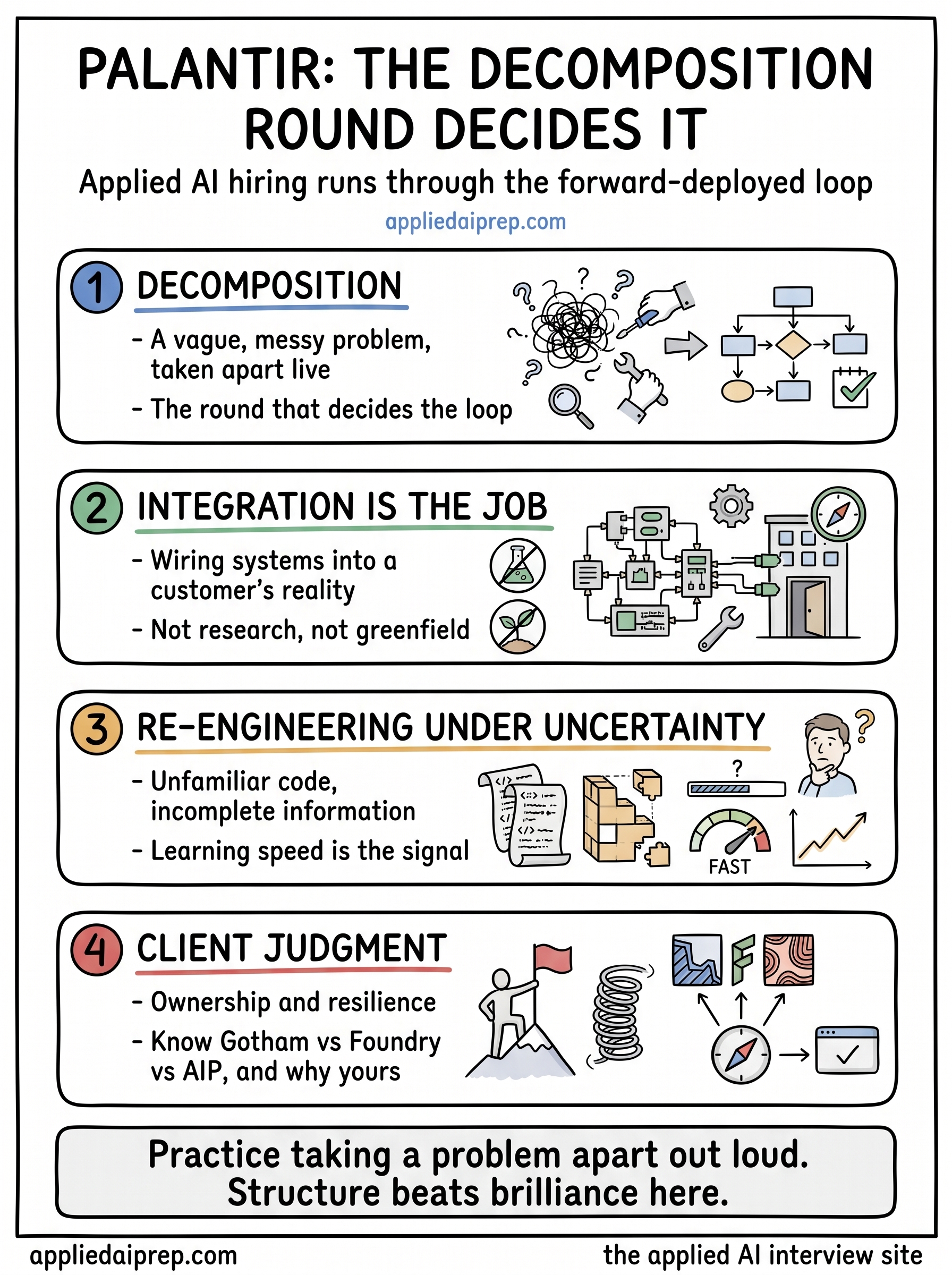
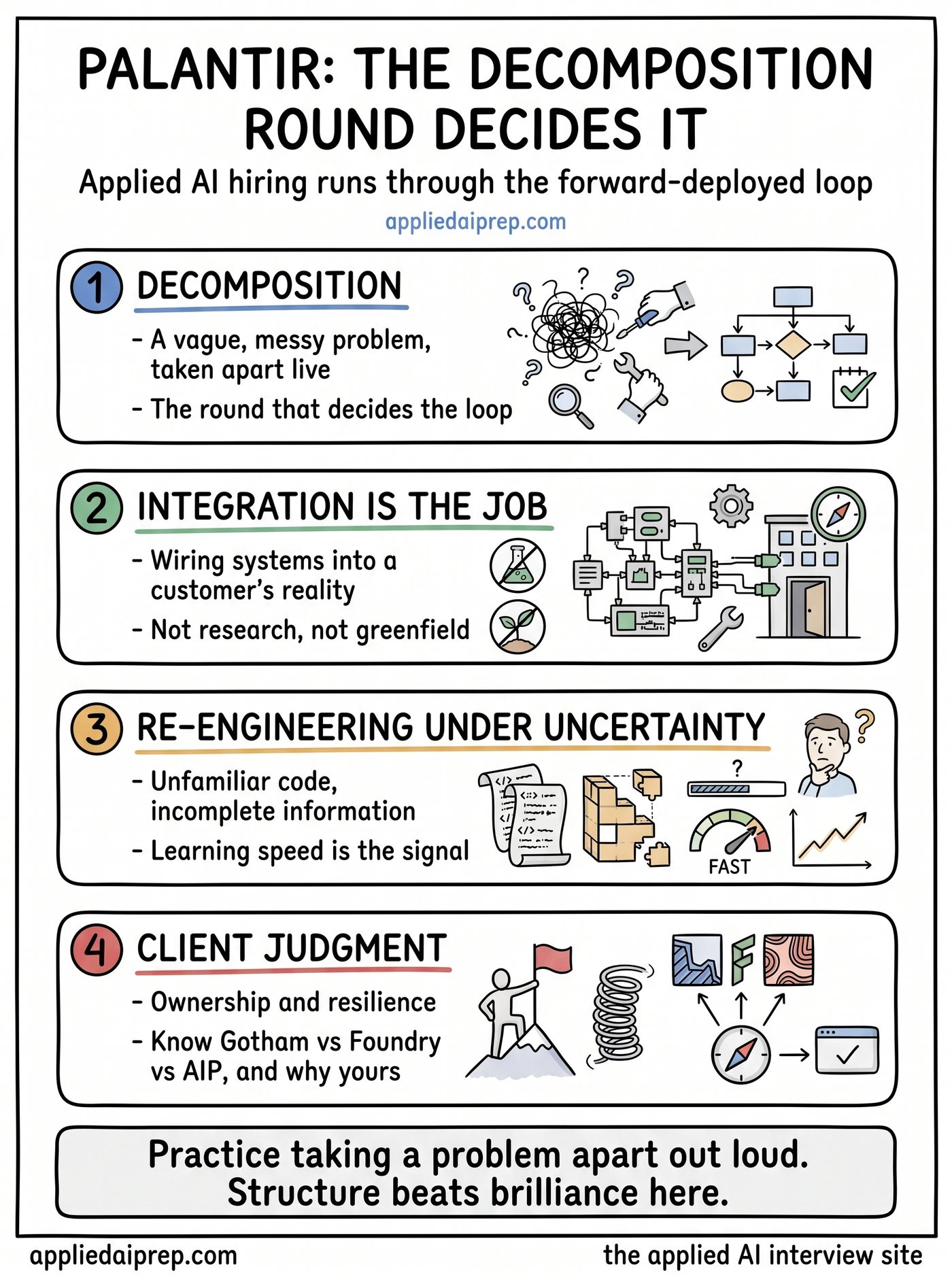
The signature stage is decomposition. You are handed an ambiguous, real-world problem, often with a thin business framing and no clean spec, and asked to break it into a structured plan. The trap is to start architecting immediately. The candidates who pass clarify first: who is the user, what decision does this enable, what data exists and where does it live, what is out of scope, and what would make this fail.
Only after the problem is bounded do they sketch a sequence of work, name the unknowns explicitly, and identify what to validate first. Speed is not the metric. Systematic reasoning is. An interviewer is watching whether you can impose order on a vague situation the way you would have to in week one of a real customer engagement. This is the same muscle the AI labs now test in their case-study rounds, and it is worth practicing on its own. We go deeper on it in the Applied AI case-study round guide.
Integration is still the actual job
Most of the real work is integration: pulling data out of systems that were never designed to talk to each other, reconciling identifiers, modeling an ontology the customer can reason about, and respecting a permission model nobody fully documented. AIP raised the stakes rather than removing the work. A model grounded in a badly modeled ontology produces confident, well-formatted, wrong answers, and now it produces them at scale and takes actions on them.
So when a design or coding prompt involves messy inputs, treat schema mismatches, missing fields, and inconsistent identifiers as the main event rather than an edge case to wave away. That instinct is what separates someone who has integrated real customer data from someone who has only consumed clean APIs. To drill the practical, integration-flavored coding this rewards, work through the coding and data-structures set.
Re-engineering and learning under uncertainty
Two rounds test something most prep ignores. In the re-engineering round you are given a 500 to 1000 line codebase you have never seen and asked to find and fix a subtle bug. In the learning round you are handed an unfamiliar API or system with minimal documentation and asked to make it do something. Both simulate the forward-deployed reality: you land in a customer environment, the systems are foreign, the docs are thin, and you still have to be productive fast.
The skill is reading code and systems you did not author. Build a habit of orienting before editing: trace the data flow, find the entry points, form a hypothesis, and confirm it with the smallest possible probe before changing anything. Narrate that process out loud. Interviewers care more about how you navigate uncertainty than whether you reach the fix in the first ten minutes.
Ownership, resilience, and client judgment
Palantir embeds client-management questions inside every technical round, usually around twenty minutes of behavioral inside the coding stage. Expect the interviewer to change the requirement mid-problem the way a customer would, or to push on what you would tell a stakeholder when the honest answer is "this will take longer than you hoped." That is the customer simulation roleplay round in miniature, run inside a coding stage instead of as its own panel. They are testing resilience and ownership: do you absorb a curveball and keep moving, or do you stall waiting for a cleaner spec.
The strongest candidates show their reasoning under pressure rather than performing certainty. When you do not know, you say so and describe how you would find out. When a tradeoff is real, you name both sides and make a call. That posture, owning the outcome instead of the ticket, is the through-line of the whole loop. It is also the trait the behavioral and customer rounds are built to surface.
Gotham, Foundry, AIP: know which one and why
You should be able to say, without hesitation, what the three are and which one a given team builds on. Gotham is the older platform, oriented toward government, defense, and intelligence work around investigative and operational analysis. Foundry is the commercial data-operations platform that integrates an enterprise's systems into a shared ontology. AIP is the layer that lets models read from that ontology and act on it under guardrails. The distinction is not academic. It shapes the customer, the security model, the data, and the kind of problems you will be dropped into.
In the motivation and final rounds, a generic answer about wanting to work on impactful AI reads as a candidate who did not do the homework. Knowing which platform the role touches, and articulating why that customer chose it, clears a filter that cuts strong engineers who treated Palantir like any other company.
How to prepare
Build one project you can defend end to end, ideally one where a model acts on data you had to integrate and clean yourself, because that is the shape of the job. Then practice the three things the loop actually weights. Decompose vague problems out loud until clarifying-before-architecting is automatic. Read and fix bugs in unfamiliar mid-size codebases under a timer so the re-engineering round feels like Tuesday. And form a real point of view on where AIP fits, grounded in the ontology story rather than a slogan.
Then calibrate against real questions. Start with the must-know Applied AI set and the Palantir signals, and treat every practice problem as also a client conversation. The interview is not asking whether you can code. It is asking whether you can be trusted alone inside a customer's hardest problem.
Turn it into offers. Work the real questions and concepts this maps to:
FAQ
It hires for the work, but rarely under that title. Palantir's applied AI engineering sits inside the Forward Deployed Software Engineer and Software Engineer reqs, and the product it ships against is AIP, the layer that puts models to work on a customer's Foundry ontology. If you are searching for a Palantir job titled Applied AI Engineer you will mostly come up empty. Apply to the forward-deployed roles and expect the loop described here.
Discussion (4)
The detail people miss: the behavioral questions are not a separate round you can prep in isolation. They are dropped into the coding and decomposition rounds, usually about twenty minutes of it, framed as 'the client just asked for X mid-project, what do you do.' Treat every technical round as also a client-management round.
Right. And the strongest tell is when a candidate asks who the user is before touching the data model. That single question separates people who have shipped to a real customer from people who have only built for a spec.
For the re-engineering round, practice reading code you did not write. Most candidates have only ever debugged their own work. Clone an unfamiliar mid-size open-source repo and fix a real issue from its tracker under a timer. That is much closer to the actual exercise than any algorithm drill.
Worth saying plainly: Gotham versus Foundry versus AIP is not trivia. If you cannot say which platform the team builds on and why the customer chose it, the motivation round reads as generic, and that is a documented way strong engineers get cut at Palantir. The AIP part is the one candidates now fumble, usually by talking about the model and never about the ontology it is grounded in.